Getting Past the Highlight: How to Teach RI.1 and Help Students Identify Strong Textual Evidence
We’ve all seen students randomly highlighting sentences, hoping they’ve found “evidence.” After starting RI.1 with my recent gallery walk activity, I realized students needed explicit modeling, clear examples, and structured scaffolding to understand and apply the standard effectively.
Explicit vs. Implicit: Understanding Strong Textual Evidence
RI.1 isn’t just about finding evidence—it’s about differentiating between explicit statements (directly stated in the text) and implicit meanings (inferences based on clues). Without clarity here, students struggle to select evidence that truly supports their claims.
Teaching Strong Evidence: Model, Scaffold, Color-Code
My approach relies heavily on clearly showing students the difference between explicit details and implicit inferences, then scaffolding practice to select strong evidence.
Step-by-Step Strategy for Teaching RI.1
- Clearly Define Explicit and Implicit
- Explicit = directly stated; Implicit = inferred based on textual clues.
- Model with engaging, relevant examples (e.g., detective scenarios).
- Explicit Modeling
- Show students clear examples of explicit statements and implicit inferences.
- Conduct think-alouds to demonstrate how you arrive at logical conclusions from clues.
- Provide Clear Criteria for Strong vs. Weak Evidence
- Strong Evidence: Direct or indirect quotes, multiple examples, clear connections to claims.
- Weak Evidence: Opinion-based, vague, unsupported, not from the text.
- Use the “Think-Pair-Share” Method
- Students individually analyze examples of evidence.
- Pair up to discuss their choices and reasoning.
- Share insights with the larger group, deepening understanding through peer interaction.
- Utilize the Thumbometer Protocol for Quick Checks
- 👍 I got it & can explain it
- 👉 I still have some questions
- 👎 I’m confused & need help
Classroom Example: Explicit vs. Implicit Evidence in Action
Students analyzed a text about an intrusion scenario. Option A provided direct textual evidence (unlocked door, muddy footprints, dog didn’t bark), clearly linking clues together. Option B was vague and opinion-based. Through paired discussions, students articulated why Option A was stronger, reinforcing their understanding of explicit and implicit evidence.
Action Steps to Implement Today
- Use explicit detective-style scenarios to illustrate the difference between explicit and implicit statements.
- Implement a clear color-coding system for categorizing strong vs. weak evidence.
- Regularly use “Think-Pair-Share” and the Thumbometer for formative assessments.
- Provide sentence starters for students to clearly articulate their reasoning.
- Consistently reinforce the practice of differentiating explicit and implicit evidence across various texts.
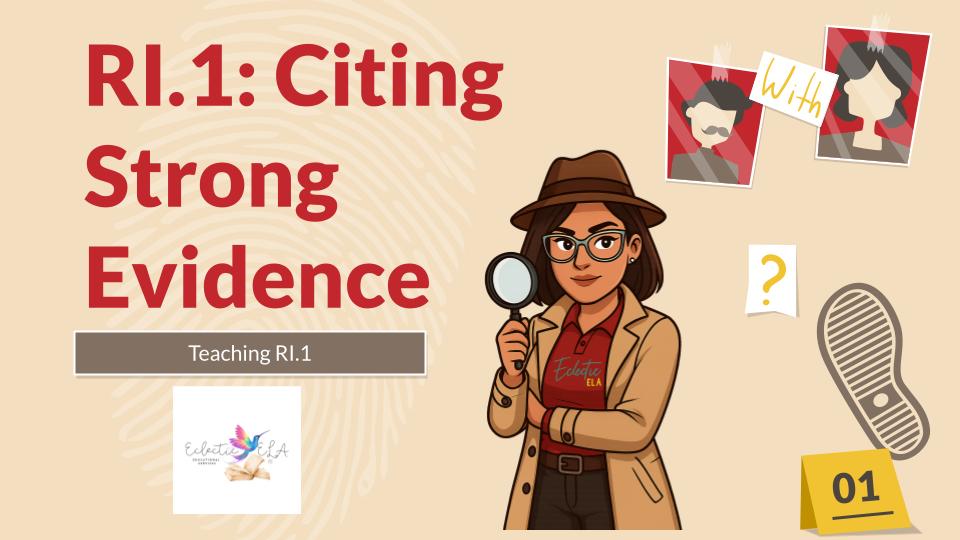
- Use this RI.1 Citing Strong Evidence Slideshow to walk students through explicit vs. implicit meanings and help them distinguish strong vs. weak evidence.
By explicitly modeling and regularly reinforcing these practices, you’ll help your students confidently navigate RI.1, transforming them from uncertain highlighters into critical, analytical readers.