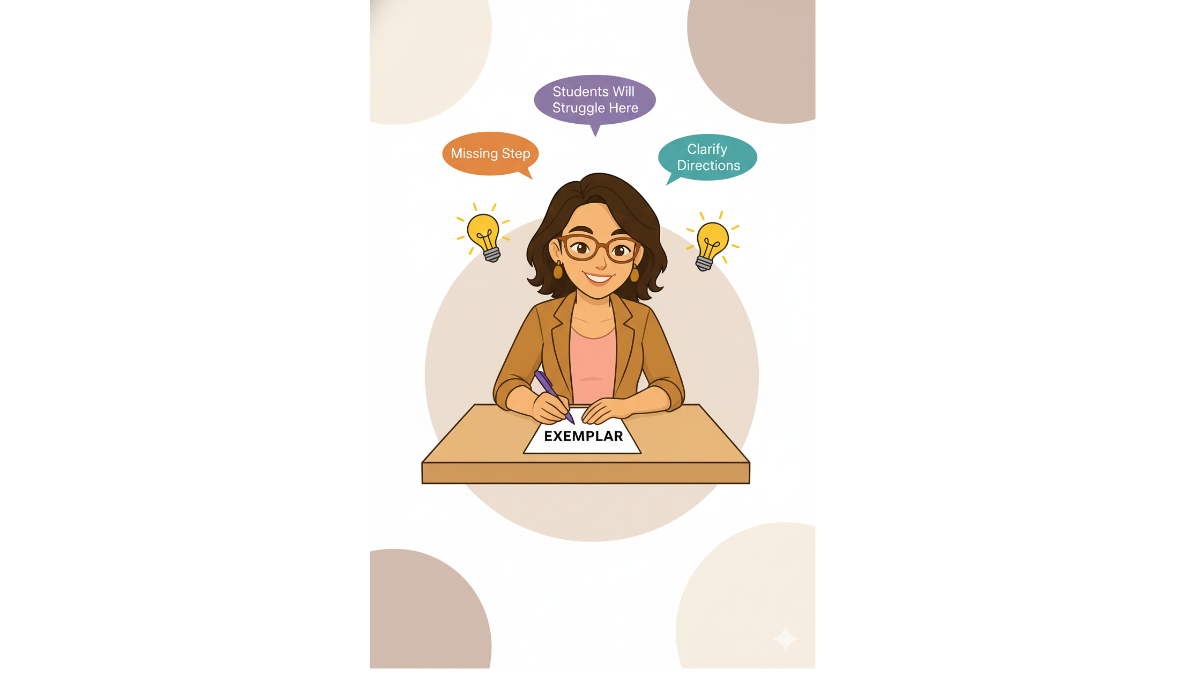
Why Students Don’t Understand the Lesson: The Hidden Step Teachers Skip
You can teach a full lesson, hit every slide, model the strategy, and still end the period staring at exit tickets that look like plot twists you didn’t see coming. Teachers always ask the same question: “Why don’t students understand the lesson?”
Most of the time, the answer isn’t effort. It isn’t behavior.
It’s clarity.
Teachers plan the activity, but not the actual end product students are supposed to produce. And when the destination is fuzzy, everything else gets fuzzy with it.
Why This Matters
If you’ve ever wondered how to make lessons clearer, here’s the truth: rigor and clarity live at the task level.
When the teacher doesn’t have a concrete vision of the final student work, the lesson drifts. Students complete tasks that don’t match the thinking you wanted. Teachers end up reteaching skills they never actually taught in the first place.
This is where the exemplar-first approach changes everything.
The Fix: Start With the Exemplar
Before planning the warm-up or printing the worksheet, ask:
“What exactly do I want students to produce by the end of this lesson?”
Then write it. A quick handwritten model is enough.
This exemplar becomes your anchor for everything else.
The Real Magic: Exemplars Reveal Struggle Points
When you complete the task yourself, you instantly discover where students are likely to get stuck.
You feel the awkward reasoning step.
You notice the missing background knowledge.
You catch directions that need tightening.
You see the misconception coming before it ever appears on an exit ticket.
This allows you to plan for the struggle instead of reacting to it later. That’s what strong instruction is—anticipating student thinking, not chasing it.
Five Action Steps You Can Use This Week
1. Write the exemplar before you plan anything else.
If the model is unclear, the task is unclear.
2. Use the exemplar to refine student directions.
Keep only what moves students toward the final product.
3. Model the thinking, not just the steps.
Students benefit most from hearing your reasoning.
4. Show the exemplar during guided practice.
Not for copying—just for calibration.
5. Use the exemplar as your monitoring tool.
Compare student work to the model as you circulate. You’ll catch misunderstandings earlier.
Takeaway
Students don’t understand the lesson when the destination is invisible.
Start your planning with the exemplar, and clarity snaps into place—for you and for them.

If you found this helpful, share it with another teacher or coach who’s planning for next week.
Thanks so much!